


Workpods, call booths, quiet boxes, acoustic cells – whatever you call them, they are indispensable in modern work environments today. Call and quiet booths offer peace and privacy, but also raise questions about fire safety. Especially in buildings with sprinkler systems or fire alarm and evacuation alarm systems (BMI/OAI), it is important to know: do they need to be secured separately? This CCV offers clear answers to this in the meantime.
Harmonisation agreements and interpretative decisions
In practice, it regularly occurs that rules and standards can be interpreted in different ways. Especially in the absence of frameworks or performance requirements in a standard, regulation, or rule, discussion quickly arises about what exactly is ‘sufficiently fire-safe’. This not only creates uncertainty for building owners, designers, and installers, but also makes assessment by inspection bodies difficult and sometimes inconsistent.
To prevent these differences in interpretation, harmonisation agreements produced in the Fire Safety Inspection Harmonisation Consultation of the CCV. This consultation is intended to enable unambiguous assessment of existing situations. These agreements help to treat similar cases in the same way and therefore offer clarity in practice. Harmonisation agreements are aimed at the assessment of existing installations for inspection bodies and are not legally binding for new designs.
In addition, the CCV's expert panel also provides practical frameworks in the form of a interpretative decision. These are applicable to the design of new buildings and installations until the interpretation decision is incorporated into a standard, provision, or regulation. For us as consultants, these interpretation decisions are indispensable. They provide us with direction in the advisory process, ensure predictability in the inspection process, and prevent unnecessary investments for our clients in facilities that subsequently prove not to be mandatory. They thus form a valuable basis for reliable and future-proof fire safety solutions.
What does the CCV say about fire safety in call and silence cells?
For both Sprinkler installations as for BMI/OAI systems Have interpretation decisions been drawn up by the CCV expert panel? These provide clarity on when a call or quiet booth must be separately equipped with a sprinkler head, smoke detector, alarm and/or flashing light. At the bottom of this news report, we have included links to download these decisions directly. Below is a summary of the principles.
Sprinkler protection: conditional exception
For sprinkler installations, a bell or silent spray booth does not need to be provided separately from a sprinkler head, provided that all the following conditions are met:
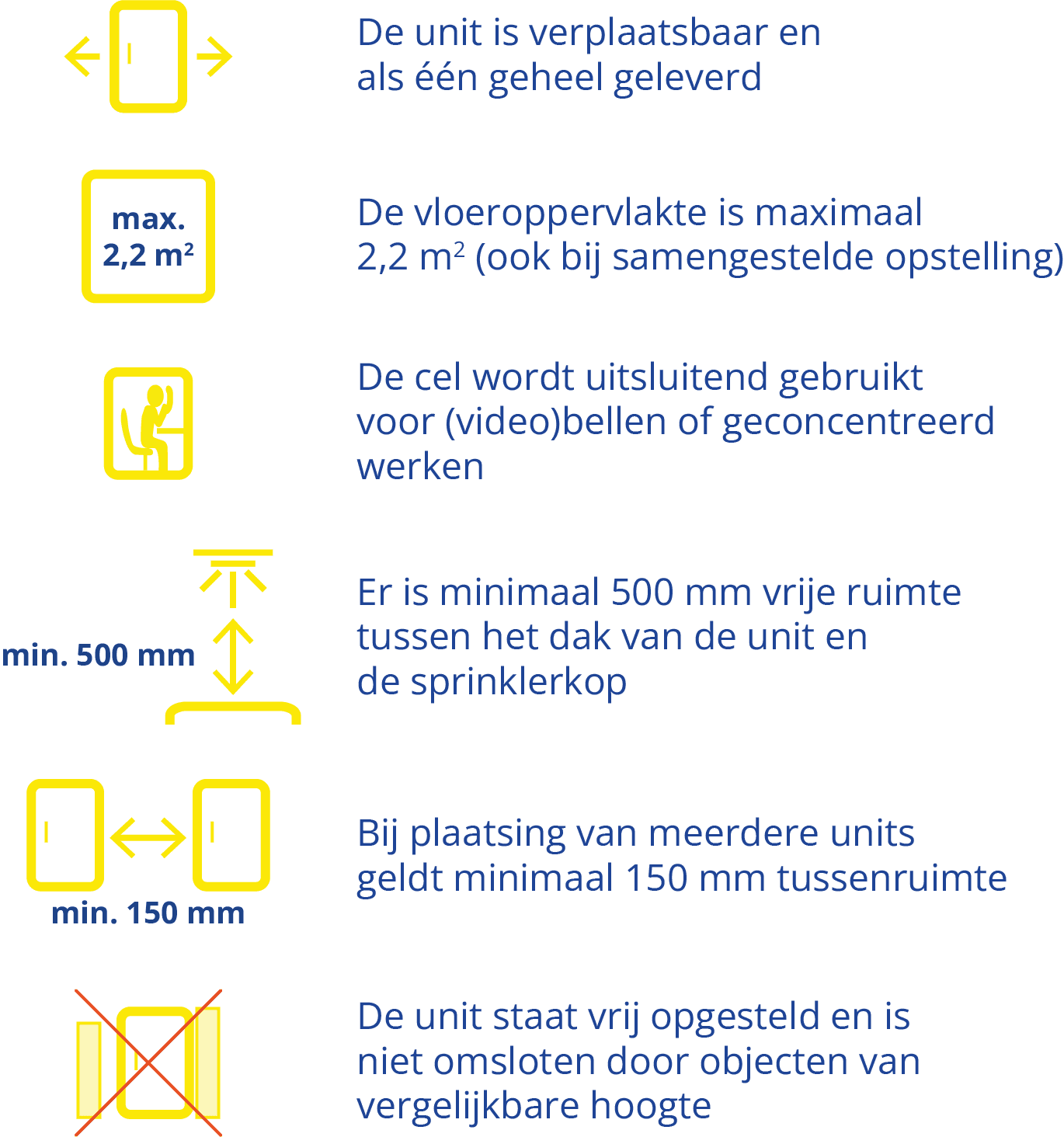
If one of these conditions is not met, sprinkler protection is still required.
Detection and alarm (BMI/OAI): limited obligation
Similarly, for fire detection and evacuation alarms, a separate provision in the bell or quiet room is not always necessary. According to the interpretation decision of the BMI-OAI expert panel, the following criteria apply for this:

Can a call or quiet room still be placed without any additional measures?
It is possible to position and use call or quiet booths in such a way that additional sprinkler protection or signalling is not required. This does, however, demand careful integral assessment beforehand. Assuming a building with sprinkler protection and a fire detection/evacuation alarm system, this means:
The unit has a maximum internal dimension of 2.0 m² (the requirement for BMI/OAI is decisive in this regard).
The positioning has been carefully chosen:
not in a dead-end escape route
150mm clearance from other objects
500mm clearance between unit and sprinkler head
Use is actually limited to short calls or concentrated work.
Environmental signal activators have been taken into account when assessing the noise level, potentially supplemented by optical signalling.
By considering these points together, mobile phone booths can be safely used without the need for additional provisions.
Overview of prerequisites per installation
| Prerequisite | Sprinkler system | BMI / OAI |
|---|---|---|
| Maximum floor area | ≤ 2.2 m² (also with combined setup) | Less than or equal to 2.0 m² |
| Free space above unit | or more than 500 mm between the roof unit and the sprinkler head | Not applicable. |
| Free space between units | 150 mm or more | Not applicable. |
| Specific use | Video calls only or quiet work | Only (video) calls; limited stay |
| Placement in escape route | Geen aanvullende eis | Not in any dead-end flight path |
| Sound pressure level of slow whoop signal | Not applicable. | ≥ 60 dB(A) in the call box |
| Speech Transmission Index (STI) | Not applicable. | Not required for Type A OAI |
| Alternative: optical signalling | Not applicable. | Allowed; claims for acoustic signalling lapse |
| Modular, movable unit | Yes, required | Yes, taken into consideration (but not a formal requirement) |
Want to know more or get tailored advice?
Would you like more information on the fire safety of call and quiet rooms in buildings with sprinkler or BMI/OAI systems? Or do you have questions about how to safely incorporate these facilities into the design? Feel free to contact us without obligation. The vb&t Brandveiligheid team can provide you with expert advice or an on-site fire safety scan.
Download the documents
Would you like to get started with the official guidelines yourself? Then download the current interpretation decisions from the CCV on fire safety in call and silence cells from below.